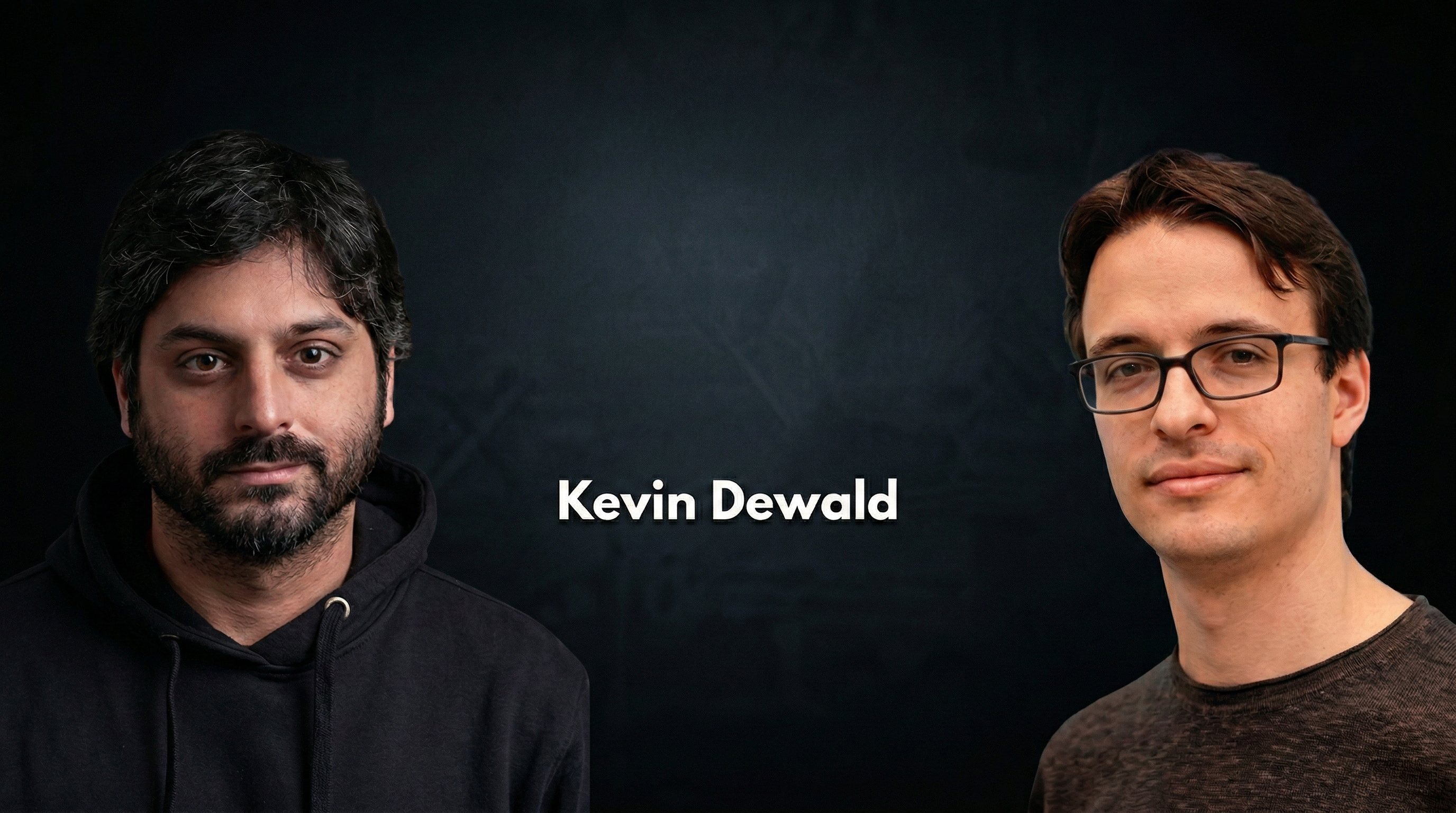
Kevin Dewald: SimpleBLE, Neuralink, and Engineering Excellence | Silver Dev
Follow Kevin Dewald's career path from engineering projects in Argentina to SimpleBLE, Neuralink and AMD. In this episode, Kevin shares his full journey, offering insights into Elon Musk's high-performance culture, the technical challenges of brain implants, and the evolution of commercial open-source.
Table of Contents
- Introduction and Origins
- From Mechanical to Electronic Engineering at ITBA and Early Projects
- Entrepreneurship in Argentina: Nerve and Spectro
- Migration to the US and the Visa System
- The Neuralink Selection Process
- Work Culture with Elon Musk: Speed and Execution
- Transition to MK1 and AMD: From Hardware to AI Software
- SimpleBLE and Commercializing Open Source
- The Future of Open Source and California Open Source
Note: The following interview was conducted in Spanish and we have translated the transcript to English. You can use YouTube's automatic subtitles to watch it in any language.
Introduction and Origins
Host (Gabriel Benmergui): Welcome to an interview that isn't from "Tecnología Informal" because that podcast is finished. I have a YouTube channel (Silver Dev) that people watch and they want to see content from there, but this isn't an official episode of the podcast because the podcast is over. Please, God, don't kill me. It's a personal promise, I can't publish new episodes of the podcast, but I found this very interesting.
In fact, I've known Kevin for a long time—I met him briefly when I was in the United States with Valentín, who was one of the first interviewees on the podcast and someone I became quite good friends with. He had a sort of ITBA reunion, I assume you know him from there, from the ITBA crowd. And well, at a party at his house I ran into Kevin and Kevin says, "No, I work at Neuralink." I say, "Neuralink? Let's start from zero. What do you do there?" And in fact, one of the stories you told me, Kevin, about Elon, is one of my go-to references when people ask me about Elon in interviews and such. So I know him from there and by sheer coincidence, well, he's making some efforts to appear in the media and they contacted me and I said, "Well, okay, let's talk because we already know each other." So well, we're going to talk a lot about migrating to the United States, working at Neuralink, what it is you do, which I find quite interesting. I have very specific questions, so I'll hand you the microphone and well, give your self-introduction.
Kevin: Sure. Well, thank you very much, Gabriel, for giving me this space. An introduction of myself: going back to the origins, I studied electronic engineering at ITBA. I actually come from a hardware background, but over time I migrated more towards software. Even within electronics, I mostly worked in the firmware area, which was where I spent a good part of my early career, and every step I took was more and more towards software, touching on cloud things, and now a lot with AI. So the path was a bit like that.
In the United States specifically, I've been here since February 2020. I landed before the pandemic started—very fun times—but in a way, I have to be grateful for that because it was what later opened the door for me to end up at Neuralink towards the end of 2020. It was a bit of a coincidence of steps, but it was what ended up leading to me being able to apply. And recently, I was working at a startup acquired by AMD a few months ago, still in the transition process, and I'm here to chat about whatever you want.
From Mechanical to Electronic Engineering at ITBA and Early Projects
Host (Gabriel Benmergui): Perfect. I found it interesting because as a programmer who went through Exactas (UBA), people who do electronic engineering are quite far from my field of vision. It's like I don't even understand what they do. To me, they're people who are given a green board and they put wires on it, you know? They're electricians and they're just there. But it's because I don't understand it. So tell me a bit: when you studied electronic engineering and said "well, I'm going to work in this," what did you imagine you were going to do? What kind of problems or what kind of companies were your target?
Kevin: Honestly, when I started studying, I had no idea what I could do. In fact, when I entered ITBA, I enrolled in mechanical engineering. I entered through that side and during the first semester, I really wanted to join a laboratory. I wanted to do things, I had time and I said: "I want to do something, I want to help, have me as the 'gofer' sweeping the floor, but let me do something." It's something my dad instilled in me: you learn by doing and you learn by being there where things happen and being a real nuisance asking "what can I do?". And they kind of stopped me quite early because, especially in the mechanical engineering department, there was nothing. The only thing they had available at that time was for fifth-year students, which was working on the Baja SAE, that little racing car, but I was super green and nobody wanted or could do anything with me.
Host (Gabriel Benmergui): The famous free work—it's very expensive.
Kevin: Yes, exactly, that's how it was. So I escalated the issue to the academic secretary: "Look, I want to do something, you're not going to let me, let me do something." And he says: "Have you thought about being in electronics instead of mechanics? Because it's much easier to get involved early there. The complexity somehow builds more gradually and I think it will be easier for them to accommodate you." Well, at that time electronics to me was black bugs and black magic, I had no idea how that worked.
I went to see a professor, Daniel Jacobi, and I asked him: "What is electronics?". And he told me: "In a way, it's the way you discover that you're making physics do things for you, think for you, or move things for you." And that stuck with me as a concept, because ultimately you're working with physical processes. Although you abstract it layer after layer, from individual transistors to programmable circuits, you already see it as something more like code, you go up to operating systems, and you move further and further away, but at the core, you're working there. The fact that you can understand from the transistor level all the way up was like: "Wow, I didn't know that world was within reach." And I said: "That's it, I'm changing majors."
That's how I started on projects. My first big project was the software for an electronic lock, an ITBA project with a company in Argentina that wanted to modernize its system. Arming a whole system that could monitor access control, register and deregister keys... Before, a technician had to go and reprogram everything. Today it's trivial, but in 2010 it was a major breakthrough.
Host (Gabriel Benmergui): Keys are a great pain in my life. You there in Menlo Park, do you have an electronic lock or do you have a key?
Kevin: No, I have a key.
Host (Gabriel Benmergui): You're prehistoric. Terrible. Twenty years ago you made that lock and look what you show me. I hate keys, I hate them. I'm willing to pay in the building to change that. But well, you worked on those kinds of projects, electronic engineering, applied circuits where you have electricity, orders, a bit of code and you see how it's applied: a microwave, a lock, a rocket...
Kevin: Everything. Towards the end of my career at ITBA, we were modernizing radar equipment for the Navy, we did the whole trajectory from end to end.
Why doesn't everything related to chips end up standardizing? Where you have a Raspberry that solves everything. Why aren't there generalized models?
Kevin: I think for two reasons. In a way, there is a lot of standardization, the issue is that within that standard you have a lot of diversity of use cases. It becomes very difficult to optimize well for certain cases if you have little variety available. For the manufacturer, it's very easy to generate a whole range of products (5V, 3.3V, 1.8V sources...). Then you have companies competing on cost and functionality. If you're a market leader and you're years ahead of the rest, you do what you want.
Host (Gabriel Benmergui): So one constraint is cost. In one you're going to make 2 million units and saving 30% on material is significant.
Kevin: Exactly. And for each item, you have four or five manufacturers competing. Sometimes they design chips to be replaceable by the competition's by being cheaper, and in other cases not. It's the same as in software. Why doesn't everyone standardize APIs? Everyone does what they want. But software has a very important degree of reuse. You can use Tailwind and 30% of new pages use the same tool.
Kevin: But that's exactly the point. They imposed themselves as the new leader. Now everyone else has to copy the same scheme to get you out of there. But Tailwind can now do what it wants. That's the magic.
Entrepreneurship in Argentina: Nerve and Spectro
Host (Gabriel Benmergui): You graduated in 2014. What happened next?
Kevin: My thesis project, Nerve—my thesis partners and I decided to see if we could turn it into a venture. This was, if my memory doesn't fail me, the second Cristina government, the peak of import restrictions, and we had the brilliant idea of wanting to start the startup in Argentina. Obviously, that went nowhere. We spent six months post-graduation working at a technical level. We did very cool things that I only saw circulating in Silicon Valley 8 years later. Technically we were very well positioned, but the financial/business part was impossible. This was on top of the whole wearable hype where there were smart drinks, smart this, smart that... we wanted to navigate that wave with very little experience.
Host (Gabriel Benmergui): If you start something physical it requires a lot of capital.
Kevin: It depends on your definition of a lot of capital. In Argentina it's one number, here in Silicon Valley $250,000 is a small ticket. Most small startups raise in the order of a million or a million and a bit just starting out. There, getting that money was impossible. Here you can iterate several times; in Argentina, if you raised the money, you better hit it on the first try because otherwise you'd go bankrupt. People don't know the difference it makes to have access to capital to be able to make attempts. I'm the founder of a small service company and every month it's: "how much money am I making?". That thing of "I have a bad quarter but I need the money" doesn't exist. I have to generate the money myself.
Kevin: Exactly. After that experiment, I stayed working at ITBA on the radar project. And towards the end of 2014, we founded another startup called Spectro. The timing coincided exactly with Macri's election. We navigated that mandate almost exactly as the country did: the first two years pum-pum-pum upwards, we reached 16 people at our peak with operations in Argentina, Chile, Ecuador. And then the second half...
Host (Gabriel Benmergui): What ate you? The currency controls? The demand?
Kevin: We got the Unit Economics wrong. We provided analytics of physical visitors in malls and stores using small devices I designed that tracked the presence of cell phones via Wi-Fi. We were pioneers in big data, generating 60GB of measurements per day. But we failed badly on the Unit Economics of how much infrastructure we were going to need. Cloud costs were $10,000 per month. The error was trying to build something for 1000 malls when we were operating with 34. The costs eroded our capital very quickly and with the decline of the economy, it became difficult to get capital to correct. The funniest thing is that at the end, in 2019, we had found a much cheaper model, but the company was already on fire. It only served to pay for a "soft landing" and close everything.
That second part was very difficult at a personal level. I wasn't drawing a salary, my wife was supporting me. I remember having 20 pesos in my pocket for lunch and feeling like a king—ironically, given how little that was. I put in a lot and that as a founder burns you out. You reach a point where you give everything and you don't take the step back to say "this doesn't deserve to stay alive anymore."
Host (Gabriel Benmergui): One piece of advice I give is to set aside a savings account with what it costs to close the legal vehicle and don't touch it. That's your emergency exit.
Kevin: Luckily the last business covered all the debts and we settled everything. Not a penny was left, but it was closed clean. It was years of a lot of emotional weight. Programmers live in a bubble because we work deregulated, but if you have to be above board it's a total mess in Argentina. The bureaucratic system is very bad and generates a lot of stress. But it hardens you.
Kevin: Yes, it leaves you better prepared. That debacle was what led me to say: "Okay, I think it's time to leave Argentina."
Migration to the US and the Visa System
Host (Gabriel Benmergui): You're a meme, the disillusioned one from the Macri era who leaves with their passport.
Kevin: It was a bit of that decision. I didn't specifically plan to end up in the United States, but evaluating where to go, I reached the conclusion that with two professional salaries in the US, one is enough to support the family and the second goes to savings. That gap was much higher than in Europe.
I contacted a company in Boston that was doing something similar to Nerve. I hit it off with the CEO and the CTO and they told me: "Come over." That was mid-2019. On February 1, 2020, I got on the plane.
Host (Gabriel Benmergui): What visa did they get you?
Kevin: The H1B CAP Exempt. The normal H1B is by lottery and you start in October. But there are institutions (educational, NGOs) that aren't subject to the CAP. This company had an agreement with UMass Boston. You work for the university one day a week (doing something like a TA) and your startup "hangs" off that visa. Many founders use that mechanism to enter while they prepare their case for an O1.
Thanks to the pandemic, the physical work rule was lifted. I could work remotely and Neuralink was able to "hang" off the same university visa while they applied for my O1. I was on that scheme for two months until the O1 came through and the visa was transferred to Neuralink.
The Neuralink Selection Process
Host (Gabriel Benmergui): How was the approach? Did you apply?
Kevin: I applied. A friend told me they were looking for firmware engineers. I applied online, filled out the questions... The most important thing was the question about the achievement you're most proud of. I told the story of Nerve, how with two pennies we achieved something technically advanced. I was very transparent about my visa issue in the application.
Host (Gabriel Benmergui): I wouldn't recommend opening with that because the person looking at the application doesn't know about visas and might discard you just in case.
Kevin: It's one of the magics of Elon's companies: if the talent is excellent, they find a way to make the other part work. A few hours later I got an email for a call. I talked to the person who ended up being my boss. It was a technical interview, he bombarded me with questions. They look for roles that, although specialized, can be conversational in related topics (electronics, software, control systems, telecommunications, power electronics).
Then they sent me the take-home assignment. I had to write a driver for a temperature sensor. It had to be robust, detect errors, test the code... I went crazy. I turned in 1000 lines of code and 12 pages of documentation for something that was solved with 100 lines. I wanted to show the whole test framework I built.
Then I had another call for "personality fit" and they invited me for an onsite. All of this happened in 10 days. The onsite was another live technical challenge (writing complex number code in C, handling infinities), a code review of a piece of code, conversations with the team, and a tour. The place reminded me of the ITBA lab: equipment everywhere, mess on the tables. It made me very nostalgic.
They told me they wanted to move forward and September 20, 2020, was my first day. I arrived just before the "Three Little Pigs" demo.
Work Culture with Elon Musk: Speed and Execution
Host (Gabriel Benmergui): What was your role?
Kevin: Embedded Systems Firmware Engineer. Code that works in the implant and systems related to the implant.
Host (Gabriel Benmergui): How much was the offer?
Kevin: 150 annually. It's competitive, market rate. They pay you a lot in "hopes and dreams." At Apple you might get paid three times more, but the mission isn't the same. I haven't found anything as impactful as the work I did there.
Host (Gabriel Benmergui): That affinity with the mission, is it yours or does the culture change you?
Kevin: A bit of both. From Argentina, I watched every SpaceX launch and got excited. Elon's companies inspired me since before he was so notorious. In Argentina, I felt the technical ceiling was very low and that I'd have to go into management. I wanted to do cutting-edge work. Elon made a huge change in something boring like cars or rockets.
At Neuralink, the gap in the speed of progress was enormous. We designed and sent chips to be manufactured two or three times a year. Anywhere else, the cycle is one or two years. Everything moves at that pace. Seeing the videos of the 20 people who already use the implant fills me with satisfaction. I helped enable that.
Host (Gabriel Benmergui): Elon talks about the sense of urgency. Is that what makes people move fast?
Kevin: It's a cultural theme of focus on "shipping" (delivering results). We all work to remove barriers. In a normal medical company, Quality tells you "you can't." At Neuralink, we asked: "what do we need to be compliant?". We used Git for change control, the Pull Request was the Engineering Change Order (ECO). The system is perfectly auditable and you don't put spokes in the wheels.
If something is going slow, we all sit down to see what's needed. It comes from the top. In large companies, the incentive to take risks falls because nobody gets fired for doing their job. At Neuralink, if there's no progress, the manager goes. There's a lot of attrition in the management part because Elon isn't happy with the progress. You have to be "on top of things." A bad answer in a meeting is "I don't know."
One-on-ones never, but I was in many meetings and presented things. He's a fairly normal person, has a human memory, forgets things because he runs five companies. But he remembers the existential risks.
We had an intern who suggested doing an X-ray tomography to see manufacturing problems. We found a cracked resistor, a microscopic crack. She put together a PowerPoint saying we needed the machine in-house. It cost two million and Elon said: "Go for it." I used that machine a lot. The 3D scan that Neuralink posted on Twitter was done by me.
Transition to MK1 and AMD: From Hardware to AI Software
Host (Gabriel Benmergui): You spent 3 years there and left. What happened?
Kevin: After 3 years you burn out. It's very intense work. My team was 2 to 6 people, many interns. It consumes you. It aligned with the opportunity at MK1. Paul Merola (Neuralink founder) was starting MK1 and asked if I wanted to join. It was easy because we already knew each other.
That allowed me to decompress. Shortly after, my wife got pregnant. At Neuralink it's very hard to have a family if you work 10-12 hours a day and weekends.
MK1 was a very opinionated version of how to do AI things: faster inference systems, agents... We were 6 months ahead of the field. But at a commercial level, it was hard to turn it into a large standalone company. We decided to join forces with AMD to push those products. I was the first general software hire, doing cloud, infrastructure, and services. It was a big change from hardware to enterprise software.
SimpleBLE and Commercializing Open Source
Kevin: I kept that original spirit alive with SimpleBLE. It started before Neuralink because Bluetooth libraries were a mess. I decided to solve it myself. It grew a lot, many companies used it. When I left Neuralink, the project went on standby and a friend suggested commercializing it.
We set up California Open Source as a legal vehicle. The surprise was that it generated a lot of interest. We use the Business Source License (BSL), although we'll probably write our own version. The problem isn't the license, but the terms of the agreement: how you control contributions, feedback, redistribution, brands, export compliance...
We sell annual development licenses. You pay for the right to develop with the library for your products. It includes support.
The Future of Open Source and California Open Source
Host (Gabriel Benmergui): Why did Anthropic buy Bon?
Kevin: My suspicion is that they needed internal features that they couldn't push with the necessary speed in a public project. The thesis of California Open Source is: which projects receive funding? If a company collaborates, it's because it helps them sell more.
The Linux Bluetooth module is maintained by an Intel employee because Intel is interested in their boards working perfectly. In large projects like Redis, when they change the license, cloud providers fork and set up a foundation. It's Game Theory: everyone collaborates because it's important for their business but not the differentiator.
I want to pay for software. There are libraries I depend on that a competent but busy guy maintains. I would pay for him to have someone and get the features I need done. The "bounties" model didn't prosper because the bounty happens outside the creator's vision. The most important thing is that the creator maintains the vision of what made the library good.
SimpleBLE is successful because it's easy to use and works. My philosophy is Zero to Value. This year we'll launch our first own hardware. All of this is possible because the project is commercial; the quality for free users improved because large companies pay for the license.
Host (Gabriel Benmergui): Thank you very much for participating. Everything you told us about Elon, Neuralink, and the visa path was very interesting. Migration is always an atypical accident in the United States. Thanks for sharing your experience.
Kevin: Thank you very much for inviting me.